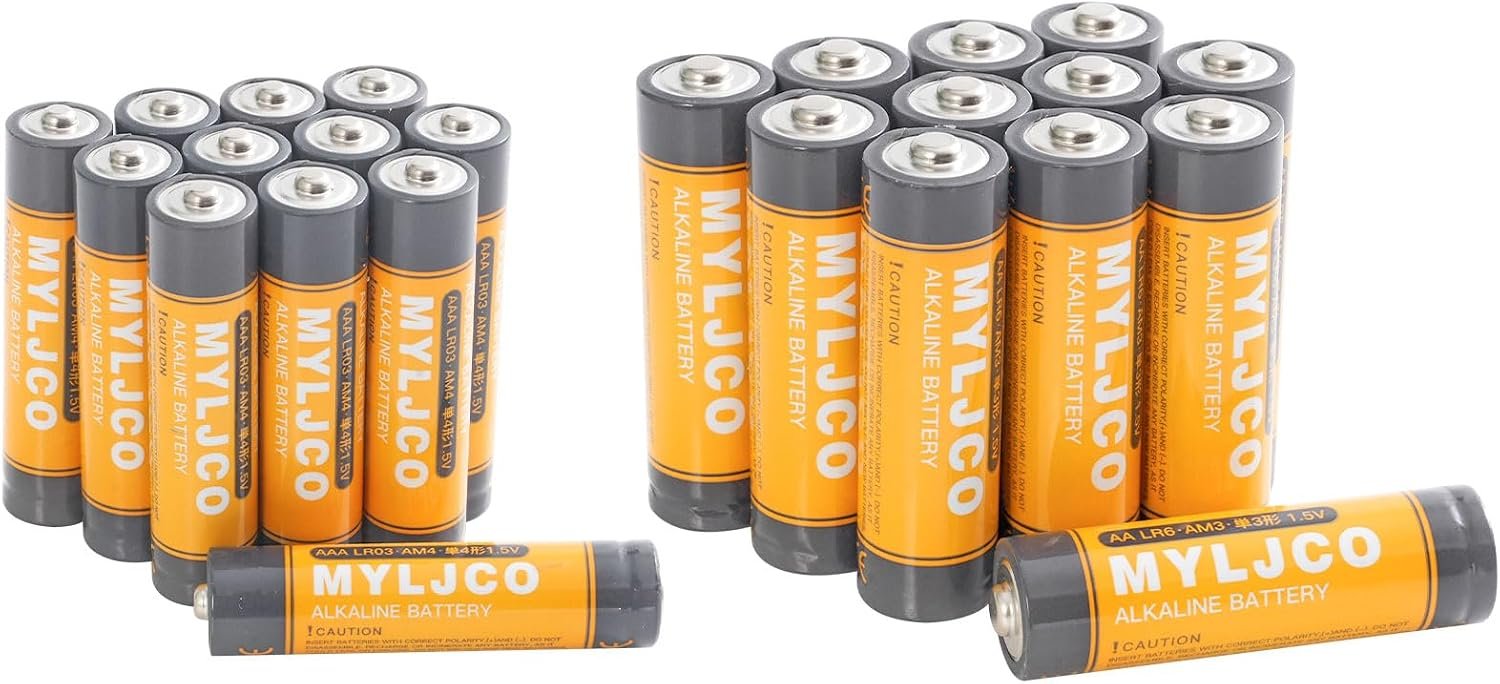
Batteries are among the smallest components in a household, yet they support a surprising number of everyday activities. Remote controls, wireless keyboards, computer mice, clocks, toys, flashlights, and many other devices depend on portable power. When a battery runs out, even a simple task can become inconvenient, especially if there are no replacements available.
Keeping a suitable supply of batteries at home can help reduce these interruptions. However, choosing and managing batteries involves more than simply looking at the quantity in a package. Battery size, device requirements, power consumption, storage conditions, shelf life, and disposal practices all influence how useful a battery supply will be.
The Upgraded 48 Count AA and AAA High-Performance Alkaline Batteries Value Pack is intended for people who need batteries for a variety of everyday devices. Its advertised 48-count format makes it relevant to households, offices, classrooms, and other environments where several battery-powered products may be used regularly.
The combination of AA and AAA battery formats is especially important because these sizes serve many different types of electronics. Although they may look similar in some respects, they are not interchangeable in every device. Understanding their differences can help users organize replacements and avoid selecting the wrong battery for a particular application.
This guide explores the practical role of AA and AAA alkaline batteries, the features associated with a multi-count battery pack, common uses, storage and safety considerations, and the differences between alkaline batteries and other portable power options.
Understanding AA and AAA Alkaline Batteries
Before considering a battery pack, it helps to understand what AA and AAA batteries are designed to do.
AA and AAA refer to standardized battery sizes. Both are commonly used in household electronics, but their physical dimensions differ.
AA batteries are larger than AAA batteries. Their additional size can make them suitable for devices designed to accommodate a larger cell, while AAA batteries are often used in smaller products where compact dimensions matter.
Neither size is automatically more appropriate for every application. The correct choice depends on the battery compartment and the manufacturer’s specifications for the device.
What Is an Alkaline Battery?
Alkaline batteries are a common type of primary battery, meaning they are generally designed for use until their available energy is depleted rather than being recharged.
A typical alkaline cell uses zinc and manganese dioxide as its principal active materials, with an alkaline electrolyte.
These batteries are widely used because they are convenient, readily available, and suitable for many everyday electronic devices.
They are particularly common in products that do not require a specialized battery system, including remote controls, clocks, toys, and various portable accessories.
An alkaline battery should not be confused with a rechargeable nickel-metal hydride battery or a lithium-based cell. These technologies have different electrical characteristics, charging requirements, and operating behavior.
Why Battery Size Matters
Battery size is more than a question of physical fit.
A device is designed around particular battery dimensions and electrical requirements. Installing the wrong type can result in poor contact, unreliable operation, or damage in some circumstances.
For this reason, users should check the battery compartment markings or the product manual before replacing a battery.
AA and AAA batteries may share a similar nominal voltage when they are conventional alkaline cells, but their dimensions and capacity characteristics differ.
A smaller battery should not be forced into a compartment designed for a larger one, and a larger battery should never be modified to fit a smaller compartment.
Key Features of the 48-Count Battery Value Pack
A Multi-Count Supply
The product title identifies the pack as containing 48 AA and AAA high-performance alkaline batteries.
A multi-count package can be useful for people who maintain several battery-powered devices. Rather than purchasing replacements one at a time, users can keep a supply available for routine household or workplace needs.
The practical value of a larger pack depends on how many batteries are needed and how quickly they are used.
A household with several remote controls, clocks, toys, and wireless accessories may go through batteries more regularly than a household that primarily uses rechargeable electronics.
Before organizing the pack, users should verify the exact quantity of each battery size listed in the product details. The overall count alone does not establish how many AA batteries and how many AAA batteries are included.
AA Battery Format
AA batteries are widely used in everyday electronics.
Common examples include certain wireless computer accessories, household remotes, toys, flashlights, portable radios, and battery-operated devices that require AA cells.
Their dimensions make them suitable for products designed to accommodate this size.
Having AA replacements available can be useful when multiple household devices use the same format.
However, battery quantity should be considered alongside actual consumption. Some devices may use several AA batteries simultaneously, while others require only one or two.
AAA Battery Format
AAA batteries are smaller and are commonly found in compact electronic products.
Examples can include slim remote controls, selected wireless keyboards and mice, small flashlights, compact toys, and other devices designed for AAA cells.
The smaller size can be useful when a product has limited space for its power source.
Because AA and AAA batteries serve different physical requirements, maintaining both sizes can help households support a wider range of electronics.
Alkaline Battery Chemistry
Alkaline chemistry is familiar to many consumers because it is used in a broad range of everyday battery products.
For suitable devices, alkaline batteries can provide convenient portable power without requiring a charging station.
This can be useful when replacements are needed quickly or when a device is not used frequently enough to justify a dedicated rechargeable battery routine.
Performance still depends on the device’s power requirements, temperature, storage conditions, and the characteristics of the particular battery.
The term “high-performance” in a product title should not be treated as a guarantee of a particular runtime. Exact endurance depends on measurable specifications and testing conditions, which should be confirmed through the product’s documentation where available.
Value-Pack Organization
A larger battery pack can support a simple household inventory system.
For example, users can store replacement batteries in a designated drawer or organizer and separate AA cells from AAA cells.
This reduces the likelihood of selecting the wrong size during a replacement.
A multi-count pack may also make it easier to track usage over time. If the household repeatedly runs out of a particular size, the inventory can reveal which format needs to be replenished more frequently.
How AA and AAA Batteries Can Be Used
The usefulness of a multi-count alkaline battery pack comes from the range of devices that rely on standard battery formats.
The following examples illustrate common applications. Compatibility should always be checked for the specific device.
Television and Media Remotes
Remote controls are among the most familiar uses for household batteries.
Television remotes, streaming-device remotes, sound-system controllers, and other accessories may use AA or AAA cells depending on their design.
Because remotes can remain in use for long periods, it is easy to overlook their battery condition until the buttons become unresponsive or the device begins operating inconsistently.
Keeping appropriate replacements available can help resolve these minor interruptions without requiring an immediate trip to purchase batteries.
Wireless Keyboards and Computer Mice
Some wireless keyboards and mice use AA or AAA batteries rather than rechargeable internal batteries.
These accessories are common in home offices, shared workspaces, schools, and workplaces.
A spare supply can be helpful when a keyboard or mouse begins showing a low-battery warning or stops responding because its cells are depleted.
However, many modern wireless accessories use built-in rechargeable batteries or proprietary power systems. Users should check their device specifications before assuming that replacement alkaline cells are appropriate.
Wall Clocks and Desk Clocks
Battery-powered clocks are another common application.
Wall clocks, alarm clocks, desk clocks, and small decorative clocks may use AA or AAA batteries depending on their design.
Clocks often have relatively modest power requirements compared with motors, bright lights, or high-drain electronics.
For devices with low and steady power consumption, alkaline batteries can be a convenient option.
The actual replacement interval varies according to the clock’s design, movement, battery quality, and operating environment.
Children’s Toys
Many toys use standard battery compartments to power lights, sounds, motors, or electronic controls.
AA and AAA batteries can be found in a variety of educational toys, remote-controlled accessories, musical toys, and interactive play products.
Because toys can vary significantly in power consumption, battery life may differ considerably from one product to another.
A toy that produces sound and movement continuously may consume energy more quickly than a toy that uses occasional electronic functions.
Battery compartments should always be closed securely, and loose batteries should be kept out of children’s reach.
Flashlights and Portable Lighting
Some flashlights and compact emergency lights use AA or AAA batteries.
Keeping replacements available can be useful during power interruptions, outdoor activities, or routine household tasks.
However, not every flashlight uses alkaline cells. Some models require rechargeable lithium-ion batteries, specialized cells, or another power source.
The battery type and polarity should be confirmed before installation.
For emergency equipment, it is also sensible to check the device periodically instead of assuming that stored batteries will remain suitable indefinitely.
Small Household Electronics
A range of household devices may use AA or AAA batteries, including selected kitchen timers, measuring devices, small radios, portable accessories, and basic electronic tools.
The exact requirements differ by product.
Some devices are designed for alkaline batteries, while others may specify rechargeable cells or particular voltage requirements.
Reading the manufacturer’s instructions is the simplest way to avoid compatibility problems.
Educational and Office Equipment
Classrooms and offices may use battery-powered presentation accessories, calculators, small electronic tools, and other portable devices.
When several people share equipment, a clearly organized battery supply can reduce interruptions and simplify routine maintenance.
For organizations, it can also be useful to designate one person or location for storing replacement batteries so that supplies do not become scattered throughout different rooms.
Who May Find a 48-Count Battery Pack Useful?
Households With Many Battery-Powered Devices
Homes with several remote controls, clocks, toys, wireless accessories, and flashlights may benefit from keeping a replacement supply.
A larger package can reduce the need to purchase small quantities whenever one device runs out of power.
The most suitable pack is one that matches the sizes and quantities actually used by the household.
Home Offices
People who use wireless peripherals and other battery-powered equipment may appreciate having replacement cells nearby.
This can be especially useful when a keyboard or mouse is needed for work and a depleted battery would otherwise interrupt the task.
A designated storage location also makes it easier to monitor remaining supplies.
Parents and Caregivers
Families may need batteries for toys, educational devices, and other household products.
A multi-count pack can help with routine replacements, although safe storage is essential when children are present.
Loose batteries should be kept in a secure location, and any battery compartment intended to be child-resistant should remain properly closed.
Classrooms and Shared Workspaces
Schools, offices, community centers, and other shared environments may have several devices that use standard battery formats.
A centralized inventory can make it easier to identify which batteries are available and which need replenishing.
Separating AA and AAA cells can also reduce confusion when multiple people maintain the equipment.
People Preparing Household Emergency Supplies
Batteries can form part of a general emergency-preparedness kit for devices such as suitable flashlights, radios, and battery-powered accessories.
The correct battery type depends on the equipment being stored.
Emergency supplies should be checked periodically, and batteries should be stored according to the manufacturer’s instructions.
A battery pack alone does not guarantee that every emergency device will be ready to use. Users should test equipment and maintain the complete kit.
Important Things to Consider Before Using Alkaline Batteries
Check the Required Battery Size
The most important step is confirming whether a device requires AA, AAA, or another battery format.
The correct size is usually indicated inside the battery compartment or in the product manual.
Never assume that two devices use the same battery simply because they look similar.
Confirm the Recommended Chemistry
Some devices work with conventional alkaline batteries, while others recommend rechargeable nickel-metal hydride cells or particular lithium batteries.
Although certain battery types may share the same physical dimensions, their electrical behavior can differ.
For devices with strict power requirements, following the manufacturer’s instructions is especially important.
Understand High-Drain and Low-Drain Uses
Battery consumption depends heavily on what a device does.
A wall clock may draw relatively little current, while a motorized toy or bright flashlight can demand considerably more.
As a result, two devices using the same battery size may produce very different operating times.
Alkaline batteries can be convenient for many everyday products, but they are not necessarily the most economical or suitable choice for every high-drain application.
Check Expiration and Shelf-Life Information
Batteries gradually age, even when they are not being used.
Manufacturers generally provide storage or expiration information on the packaging.
When organizing a larger pack, keep the original packaging or record relevant dates where practical.
Use older suitable stock first, provided it has been stored correctly and remains within the manufacturer’s recommended period.
Store Batteries Correctly
Storage conditions can affect battery performance and safety.
A cool, dry location away from direct sunlight and excessive heat is generally appropriate, subject to the manufacturer’s instructions.
Avoid leaving batteries in hot vehicles, near heaters, or in locations exposed to moisture.
Do not store loose batteries alongside metal objects such as coins, keys, paper clips, or tools. If conductive objects bridge the battery terminals, they can create a short circuit.
A dedicated battery organizer or the original packaging can help keep cells separated.
Do Not Mix Old and New Batteries
When a device requires multiple batteries, follow the manufacturer’s instructions and replace the cells as a complete set when recommended.
Mixing old and new batteries, different chemistries, or different battery types can cause uneven discharge and may increase the risk of leakage or device damage.
It is also important to insert batteries with the correct polarity.
Watch for Leakage or Corrosion
Batteries can leak if they are damaged, improperly stored, excessively discharged, or left in equipment for extended periods under unsuitable conditions.
If a battery leaks, avoid direct contact with the material and follow the battery manufacturer’s cleanup and safety guidance.
Do not use a battery that appears swollen, damaged, corroded, or otherwise abnormal.
If a device will remain unused for an extended period, check its instructions to determine whether the batteries should be removed.
Keep Batteries Away From Children
Small batteries present serious ingestion hazards, particularly for young children. Although AA and AAA batteries differ from small button cells, loose batteries should never be treated as toys.
Store them securely and supervise battery replacement where appropriate.
If a child may have swallowed a battery, seek emergency medical assistance or contact the appropriate poison-control service immediately. Do not wait for symptoms.
Dispose of Used Batteries Responsibly
Used alkaline batteries should be handled according to local waste-management guidance.
Collection and recycling options vary by location. Some communities accept household batteries through designated collection programs, while others provide different disposal instructions.
Do not assume that every battery can be placed in the same recycling container.
Before disposing of batteries, check local rules and follow any instructions provided by the manufacturer or waste-management authority.
Alkaline Batteries Compared With Other Battery Types
Different battery chemistries serve different purposes. The appropriate choice depends on how frequently a device is used, its power requirements, the initial cost of equipment, and the user’s preference for charging or replacing cells.
Alkaline Batteries vs. Rechargeable NiMH Batteries
Rechargeable nickel-metal hydride batteries can be charged and reused many times when used with a compatible charger.
They may be useful for devices that consume batteries frequently, such as certain toys, wireless accessories, and frequently used flashlights.
Alkaline batteries, by contrast, are generally intended for single use.
For devices that consume large quantities of batteries, rechargeable cells may reduce the number of disposable batteries required over time.
However, rechargeable batteries require a compatible charger and a charging routine. Their suitability also depends on the device’s voltage requirements and whether it is designed to work properly with rechargeable cells.
Alkaline Batteries vs. Lithium Primary Batteries
Some non-rechargeable lithium batteries offer different performance characteristics from alkaline cells, including potentially better operation in certain temperature ranges or a longer shelf life in specific product categories.
Their characteristics depend on the exact lithium chemistry and battery design.
Lithium primary cells are not interchangeable with alkaline batteries in every application, even when the physical dimensions appear similar.
Users should follow the device manufacturer’s battery recommendations rather than selecting a chemistry based only on general performance claims.
Disposable Batteries vs. Built-In Rechargeable Devices
Many modern electronics use integrated rechargeable batteries.
Wireless earbuds, smartphones, rechargeable flashlights, and numerous computer accessories may not accept replaceable AA or AAA cells at all.
A multi-count alkaline pack is therefore most relevant to devices specifically designed around replaceable batteries.
It cannot replace the charging system of a device with a built-in battery.
How to Organize a Household Battery Supply
A little organization can make a large battery pack more useful.
Separate Battery Sizes
Store AA and AAA batteries in separate compartments or clearly labeled sections.
This reduces the chance of choosing the wrong size during a quick replacement.
Keep Packaging Information
The original packaging may contain useful information about the battery type, storage conditions, and expiration date.
If the packaging is discarded, keep the relevant details in an inventory note when necessary.
Use Older Suitable Batteries First
Where several packs are stored, rotate stock so that older batteries are used before newer ones, provided they remain in suitable condition and within the manufacturer’s guidance.
This can help reduce the likelihood of batteries remaining unused for unnecessarily long periods.
Create a Simple Inventory
For households with many battery-powered devices, an inventory can be helpful.
A basic list might include:
- Device name
- Required battery size
- Number of cells needed
- Last replacement date
- Approximate remaining supply
This can be particularly useful in offices, classrooms, and shared homes where several people use the same equipment.
Check Devices Periodically
Do not wait for every device to stop working before checking its batteries.
For emergency lights, radios, and other equipment that may be needed unexpectedly, follow the manufacturer’s testing and maintenance recommendations.
Frequently Asked Questions
What is included in the Upgraded 48 Count AA and AAA Alkaline Batteries Value Pack?
The product title identifies a 48-count pack of AA and AAA high-performance alkaline batteries. Check the current Amazon listing for the exact breakdown between AA and AAA cells and any additional product specifications.
What are AA batteries commonly used for?
AA batteries are used in many household electronics, including certain remote controls, wireless accessories, toys, flashlights, clocks, and portable devices designed for this size.
What are AAA batteries commonly used for?
AAA batteries are frequently used in smaller electronics, including certain slim remotes, wireless mice, keyboards, compact flashlights, toys, and other devices designed for AAA cells.
Can AA and AAA batteries be used interchangeably?
No. They have different physical dimensions and are intended for different battery compartments. Always use the size specified by the device manufacturer.
Are alkaline batteries rechargeable?
Conventional alkaline batteries are generally designed for single use and should not be recharged unless a product is specifically labeled as rechargeable and the manufacturer provides appropriate charging instructions. Attempting to recharge ordinary alkaline batteries can cause leakage, rupture, or other hazards.
How long do alkaline batteries last?
Battery life depends on the device’s power consumption, usage frequency, temperature, battery characteristics, and storage conditions. A low-drain clock may use a battery much longer than a high-drain motorized device.
Are alkaline batteries suitable for wireless keyboards and mice?
They can be suitable for wireless keyboards and mice that are specifically designed to use AA or AAA alkaline cells. Some modern models use built-in rechargeable batteries, so the device specifications should be checked first.
How should unused batteries be stored?
Follow the manufacturer’s instructions. A cool, dry location away from direct sunlight and excessive heat is generally appropriate. Keep batteries separated from conductive metal objects and out of children’s reach.
Can different battery brands be mixed in one device?
It is generally preferable to use matching batteries of the same type and replace them together when the device requires multiple cells. Mixing old and new batteries or different chemistries can lead to uneven discharge and may increase the risk of leakage or device damage.
Are alkaline batteries appropriate for emergency kits?
They can be appropriate for compatible devices such as certain flashlights and radios. Emergency supplies should be checked periodically, and the required battery type should be confirmed for each device.
How should used alkaline batteries be disposed of?
Follow local waste-management guidance. Recycling and disposal rules vary by location, so check the requirements in your community rather than assuming all battery types follow the same process.
What should I do if a battery leaks?
Avoid direct contact with the leaked material and follow the manufacturer’s safety and cleanup instructions. Do not continue using a damaged battery. If leakage has affected a device, consult its manufacturer for appropriate cleaning guidance.
How can I tell whether a battery is still suitable for use?
Check for visible damage, corrosion, leakage, or other abnormal conditions, and follow the manufacturer’s storage and expiration guidance. For equipment where dependable operation is important, test the device periodically rather than relying only on the battery’s appearance.
Conclusion
The Upgraded 48 Count AA and AAA High-Performance Alkaline Batteries Value Pack is intended for users who need a supply of standard disposable batteries for everyday electronics. A larger pack can be useful when several devices rely on replaceable AA or AAA cells, particularly in homes, offices, classrooms, and shared workspaces.
The main practical advantage of keeping a battery supply is convenience. Having the correct replacement available can help restore the operation of a remote control, clock, wireless accessory, toy, or flashlight without interrupting an activity to obtain another battery.
However, a battery pack is only useful when its contents match the devices being powered. AA and AAA batteries have different dimensions, and not every electronic product is designed for alkaline chemistry. Checking the device manual, confirming the exact battery size, and following the manufacturer’s recommendations remain essential.
Storage and safety also deserve attention. Batteries should be kept in suitable conditions, protected from short circuits, stored securely away from children, and replaced or disposed of according to the relevant instructions. Households that use batteries regularly may also benefit from separating sizes and keeping a simple inventory.
For people who frequently use battery-powered household electronics, understanding these basic details can make replacement and storage more straightforward. The most useful battery supply is not simply the largest one, but the one that matches actual device requirements and can be stored and managed safely.
Leave a Reply